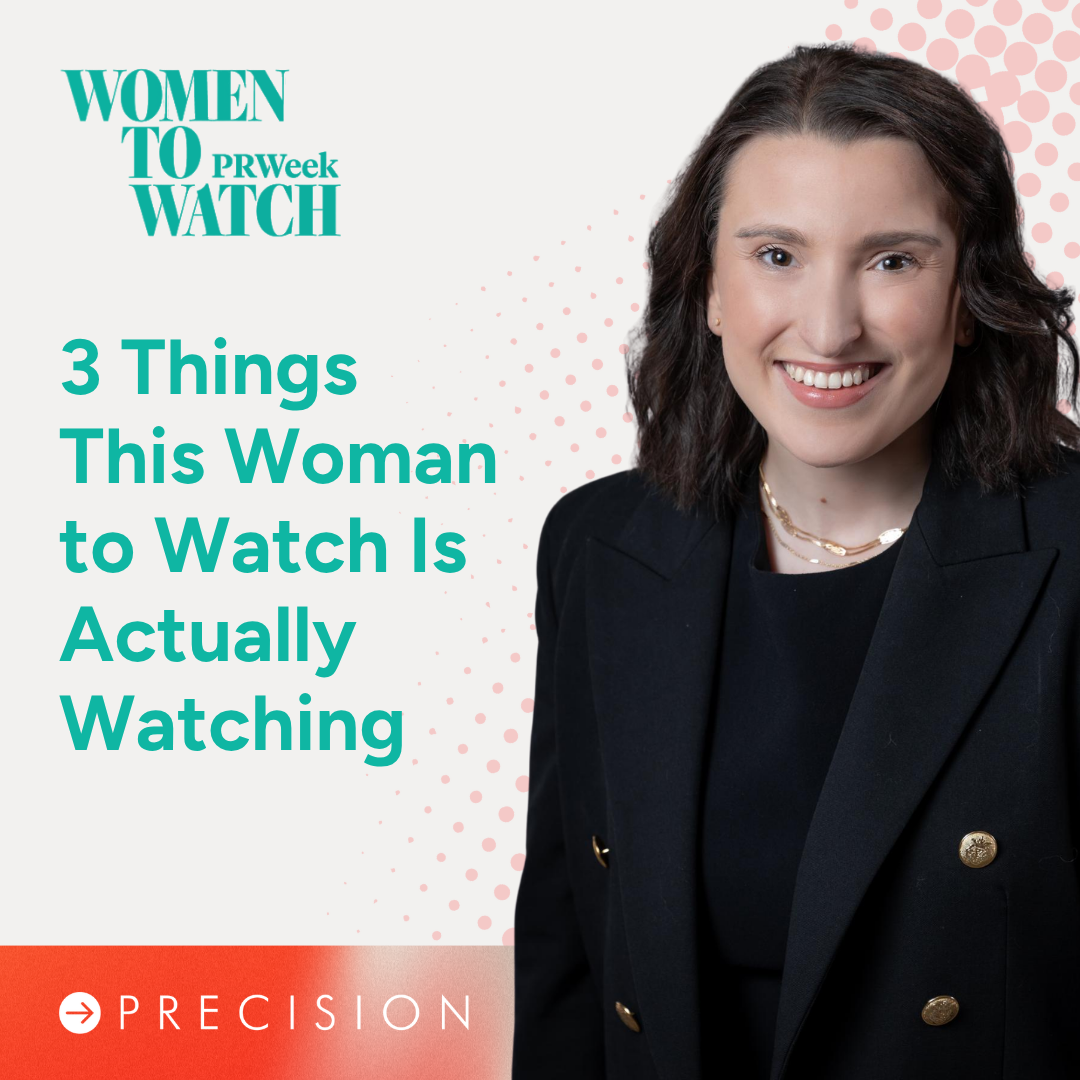
3 Things This Woman to Watch Is Actually Watching
How and when brands, organizations, and campaigns need to reach their audiences is shifting faster than most strategies are moving. And while we’ve all seen the many think pieces on how to bolster the influencer ecosystem to reach men more effectively, there are a number of other trends that will be just as determinative of campaign success and aren’t getting nearly the same level of attention as Theo Von’s TikTok reach.
I’ve been running political ad campaigns for enough cycles to know that the teams that proactively implement new digital tactics and investments are the ones that see the biggest returns, not necessarily the ones with the biggest budgets. The same is true for public affairs campaigns, just on less-fixed timelines and with different audiences.
So in the spirit of my recent PRWeek Women to Watch recognition, here are a few industry shifts I’m actually paying attention to right now.
1. Generative search needs to play a much larger role in public affairs media strategy than most organizations are accounting for right now.
There’s no shortage of energy around AI right now. Everyone has a take. But fewer organizations have translated those takes into actual media strategy. Most teams are still treating generative search like an SEO or content problem. From where I sit, it’s certainly about content, but even more about where and how that content actually shows up.
People, especially younger audiences, are increasingly starting with AI tools to understand issues, companies, and policy environments. It’s the 2026 version of TikTok as a search engine. That dynamic is just as true for voters evaluating ballot issues as it is for someone trying to sort through misinformation about vaccines. By the time they see your ad, they’re often not forming an opinion, they’re confirming one that’s already been framed for them.
That should change how you think about where your message shows up, how it shows up, and what context surrounds it. And right now, most paid media strategies are not accounting for that at all. What that means in practice is using these insights to more intentionally shape paid strategy across social, search, and contextual placements, ensuring your message is present in the environments influencing how issues are being understood in the first place, not just where ads have traditionally lived. That work becomes even more important as we move toward a world where those same dynamics will extend directly into AI platforms themselves.
At Precision, we’ve started building this into how we advise clients through our TerrAIn offering which helps organizations understand not just where their message appears, but how it’s being interpreted, surfaced, and reinforced in an AI-shaped information environment. For more about TerrAIn – read more from my colleague Elaine Ogden here.
2. Effective targeting is moving from who people are to how they experience media.
For decades, audience targeting in public affairs and campaigns has been built around identity: party affiliation, demographics, geography, or modeled voter segments. Those signals still matter, but leaning on them exclusively is like calling a running play every down. Eventually, the defensive team figures it out. Case in point with my beloved Eagles and their overreliance on Saquon Barkley this past season (I don’t have enough space to offer my thoughts on Kevin Patullo!)
What’s actually driving performance now is how audiences experience content: the environment, the tone, the messenger, and whether they’re paying attention when it shows up.
For instance – a Hill staffer reading the news during the workday is in a completely different mindset than that same staffer watching Bravo at 11pm. One is looking for information. The other is there to be entertained, and anything that doesn’t feel native is easy to ignore. That fragmentation shows up even more with general audiences. Someone might engage with a Nick Fuentes meme on Instagram and later that day spend time reading about the gutting of USAID. Those behaviors don’t cancel each other out, but they also don’t translate into a clean targeting profile.
That’s why a single signal, such as how someone voted or what they clicked on, is no longer a reliable shortcut for how to reach them. Our team saw this trend and adapted – mapping via modeling and tools, such as TerrAIn, how audiences move across platforms, what mindset they bring into each environment, and we launched a Content Studio to produce in-platform creative that feels native – and our clients are seeing stronger results because of it.
3. Vanity metrics are losing their grip in the C-suite—and it’s long overdue.
Over the last year, we’ve seen a marked increase in C-suite executives starting to push harder on impact and metrics in their teams’ campaigns. “How many people did we reach?” is becoming a less satisfying metric than “Did anyone actually engage and did it change anything?” And that’s a good thing, because in campaigns where every dollar has to justify itself quickly, that difference matters.
This shift is moving measurement toward indicators that reflect attention, not just exposure. Whether someone actually stayed with the content, processed it, and engaged with it. Those signals make ROI and impact clearer for the C-suite and for us as your thought partners. But just as importantly, they are pushing more organizations to invest in the tools that make those insights possible.
Brand lift studies and randomized controlled trials have been a core component of our campaigns for years. They are not add-ons. They are foundational tools that help our clients understand what is actually working. Increasingly, clients are asking for them as core infrastructure, not optional enhancements.
In a campaign and advocacy context, these tools reveal what is moving persuadable voters in real time. In public affairs, they give leadership a clearer view into whether a campaign is driving meaningful shifts in perception or behavior. In both cases, they create the kind of evidence that makes it easier to scale investment or change course when something is not working.
The organizations that demand this level of rigor will have a real advantage, not just in proving impact, but in actually improving it.
—
These trends are already shaping how audiences form opinions, how campaigns perform, and how leadership teams evaluate whether a campaign is working.
The most successful paid media campaigns over the next year will be the ones willing to adjust how they strategize. Not just what they say or where they show up, but how they think about influence altogether.
Our team at Precision is focused on helping clients close that gap by translating these shifts into smart strategy and results that actually matter.

Natasha del Amo | Vice President, Paid Media
Natasha del Amo is a vice president of paid media, where she helps translate our clients’ programmatic and organizational goals into sharp and effective advertising campaigns that meet the moment.
Natasha has extensive experience with integrated campaigns, having led and executed advertising strategy, creative, media strategy and innovative testing for online and offline paid media campaigns across the globe. With almost a decade of experience in paid media and digital strategy, Natasha brings a surround-sound POV that helps bolster the efforts of nonprofits, governments, political campaigns, Fortune 500 companies and advocacy organizations. Her clients have included the Fan Fairness Coalition, the American Academy of Pediatrics, TechNet, and Fortune 500 companies.