Eight Things You Need to Know About the State of Media From the Inaugural Status Summit
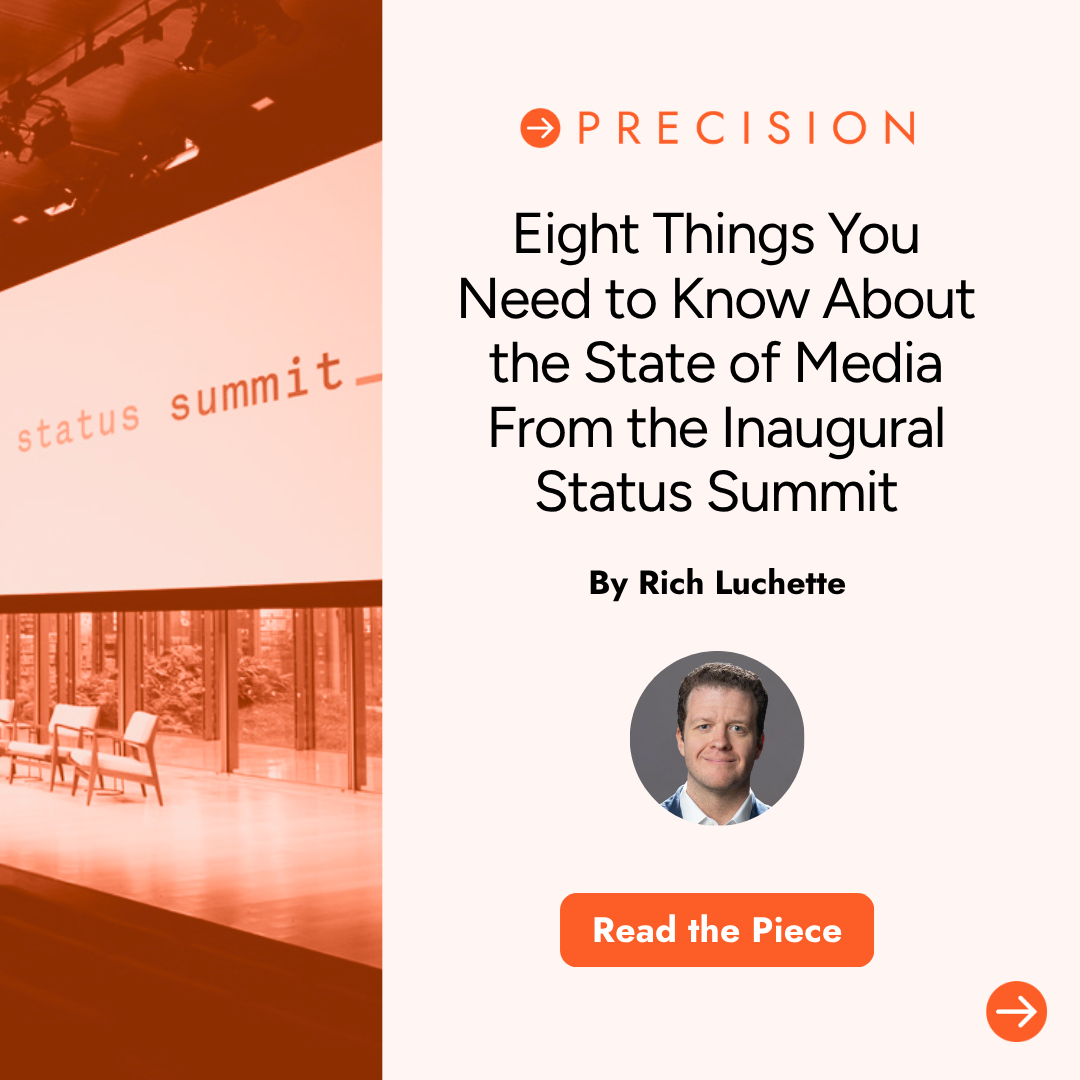
Oliver Darcy’s Status held its first live summit in New York on Wednesday, September 9th, convening media executives, anchors and independent journalists who are reshaping the news business. Here are eight key takeaways from the day, and what you can do about them:
1. The Audience Has Moved, and the Inventory Is Underpriced.
MSNOW president Rebecca Kutler said the network is the No. 1 TV news brand on YouTube, drawing more monthly clicks than ABC, NBC and CBS News combined and more unique digital visitors than The Atlantic, Axios or Politico.
Its membership product launched the morning of the summit, built from research with 18,000 people and aimed at what she calls “future fans” – the news-hungry people in their 20s, 30s and 40s who will never buy cable.
MSNOW’s Nicolle Wallace gets 24 to 27 million YouTube views per month. Zeteo has 2.2 million YouTube subscribers, with 95% of revenue from subscribers. Brian Williams, former Managing Editor and Anchor of NBC Nightly News, and Jonathan Wald, who worked as Executive Director for both NBC Nightly News and Today, said the streaming election-night broadcast they built last cycle outperformed every broadcast network threefold among younger viewers and drew a bigger audience than CBS and Fox’s network coverage outright.
Stay Ahead of the Curve: News-adjacent inventory is cheap right now for reasons that have little to do with performance. Status founder Oliver Darcy opened the day noting advertisers remain allergic to news. YouTube-first programming and local newsletters are the most underpriced placements in the market, and both over-index on the audiences hardest to reach elsewhere.
2. Publishers Have Standardized the AI Playbook.
New York Times CEO Meredith Kopit Levien and Atlantic CEO Nicholas Thompson described nearly identical decision trees for handling AI developers despite having taken opposite public paths. You look at the deal terms, Thompson said, and then you block them, partner with them, or sue them. Had Atlantic’s OpenAI negotiation failed, he added, blocking was set to be step one and suing step two.
The Atlantic has deals with OpenAI and Particle while joining the News/Media Alliance suit against Cohere; the Times has sued OpenAI, Microsoft and Perplexity, while separately striking a licensing partnership on terms it set. Levien framed LLMs as having four inputs: Talent, energy, compute and data. Developers spend tens of billions on the first three while treating the fourth, journalism, as free. Her four conditions for any deal: permission, control over use, fair value exchange, and sustainability.
Stay Ahead of the Curve: Levien’s four-part test is a useful frame for any organization whose research and content is being ingested. Decide deliberately whether your material should be blocked, licensed or made maximally citable. And stop grading earned media on referral traffic; search volume is still falling across the board.
3. The President as Editor-in-Chief.
Former President and CEO of CBS News and Stations Wendy McMahon was direct: There are decisions being made in newsrooms right now out of fear of retribution from the current administration. Full stop.
She pointed to Disney’s suit over the FCC’s review of its eight owned stations, which alleges the company re-thought editorial decisions under pressure and noted that The View stopped booking political guests. ABC turned over 13,000 documents before concluding cooperation was never going to be enough. Once you bend the knee, McMahon warned, you can get used to the view from there.
Stay Ahead of the Curve: For pitching guests, build longer lead times and more fallback options into any placement touching politics, regulation or litigation. A booker’s “no” increasingly reflects their own corporate and legal exposure, not the quality of your pitch. Reading it as a rejection of the story could cost you your relationship.
4. Appeasement is on the Wane.
McMahon also noted a pendulum swing as the midterms approach. Companies have now recognized there is no positive outcome in capitulation. Recode co-founder and tech journalist Kara Swisher said tech executives who normally avoid her have suddenly started texting again. And when CNN’s Kaitlan Collins closed the day by asking Darcy to say what trend he saw coming, he said that major media companies will start making inroads with Democrats and abandoning Trump as he loses power. Darcy also expects Congressional Democrats, should they win subpoena power, will have pointed questions about how the Paramount and Warner Bros. Discovery deals were done.
Stay Ahead of the Curve: Assume that every alignment decision made over the last two years will be re-litigated after November. Companies that have done business with the administration should inventory theirs now – statements, settlements, sponsorships, appearances, silences – and have an answer for each before someone else writes their story.
5. Fortune 500 Silence is the Story of the Era.
DealBook’s Andrew Ross Sorkin made the sharpest argument of the day: The American CEO community has been more silenced on most issues than at any point in his career.
When the tariffs first landed, no Fortune 500 company brought the challenge. Only a handful of very small firms did. Neither the Business Roundtable nor the Chamber of Commerce joined them in support.
When the Supreme Court eventually ruled against the tariffs, the largest companies didn’t seek their refunds, again, for fear of retribution. Sorkin put the question around fear of retribution to the President directly when he called in to Squawk Box, which the President acknowledged, saying “I’m honored that you would say that, Andrew, and I will remember those companies.”
Sorkin’s conclusion is worth sitting with – If companies are not willing to flex the muscle, do they really have any power?
Stay Ahead of the Curve: Define your escalation ladder before you need it: What triggers a public statement, a coalition letter, a legal filing, or deliberate silence – whatever course you take, it will be noticed by both those in power and those about to be. Silence is its own statement. Sorkin also noted that what executives say on camera and what they say during the commercial break are two different things. Treat that gap as a liability, because it can eventually become a story.
6. Legal Exposure Is a Line Item Now for Publishers.
Zeteo founder Mehdi Hasan said his outlet spends tens of thousands of dollars annually on defamation insurance, with costs climbing, and argued the U.S. is drifting toward the U.K.’s more hostile climate as efforts to undermine free speech and erode NYT v. Sullivan continues.
Darcy said Status buys as much coverage as it can and doesn’t produce its podcast live, because live programming isn’t covered. Reporters can’t just call insurers and ask for a policy – carriers want to know who edits, where they trained, and how long they’ve done it.
Stay Ahead of the Curve: Placing sensitive stories with independent outlets can be risky. Insurance, counsel and pre-publication review determine what a newsroom can publish, how quickly, and whether it holds when the threat letter arrives.
7. Direct Relationships Are the Only Metric That Compounds.
Levien’s framing was the most useful of the morning: Subscriber counts and ad revenue are lagging, not leading, indicators. The actual leading indicator is engaged audience, meaning the people who come to you directly, form a habit and ask for you by name.
She rejected the idea of a subscription ceiling outright, and cautioned against confusing the waning of the link-based web with underlying demand for quality information. Thompson reported roughly 20% annual growth at The Atlantic in both subscriptions and advertising against overhead that has been flat for five years. The outlet is now increasing its print run partly as an AI hedge, because there’s no AI middleman in the U.S. Postal Service.
Stay Ahead of the Curve: Your list, your members and your events are the only channels no platform can reprice overnight. Fund them like infrastructure rather than campaigns, and measure habit and repeat engagement rather than reach.
8. Style Guides Have Become Public Policy.
Associated Press executive editor Julie Pace is applying the same standard to Lake Ontario that she applied to the Gulf of Mexico: A name in use for 400 years, predating both bordering countries, stays.
Pace was emphatic that the AP’s lawsuit isn’t about a body of water – it’s about being retaliated against for the words an organization chooses, which the First Amendment prohibits. The AP won at the district level before a Trump-appointed judge and is awaiting an appellate ruling.
Darcy said that when he asked major outlets for their guidance, he mostly got silence. Many quietly split the difference in 2025 by simply saying “The Gulf.” The New Yorker’s David Remnick had a one-word name for that kind of accommodation: obedience.
Stay Ahead of the Curve: Terminology decisions are now read as positioning, including by reporters who will ask you to explain them. Set your house style deliberately, write down the reasoning, and recognize that quietly dropping a contested word is itself a choice that gets noticed, not a way to avoid making one.